
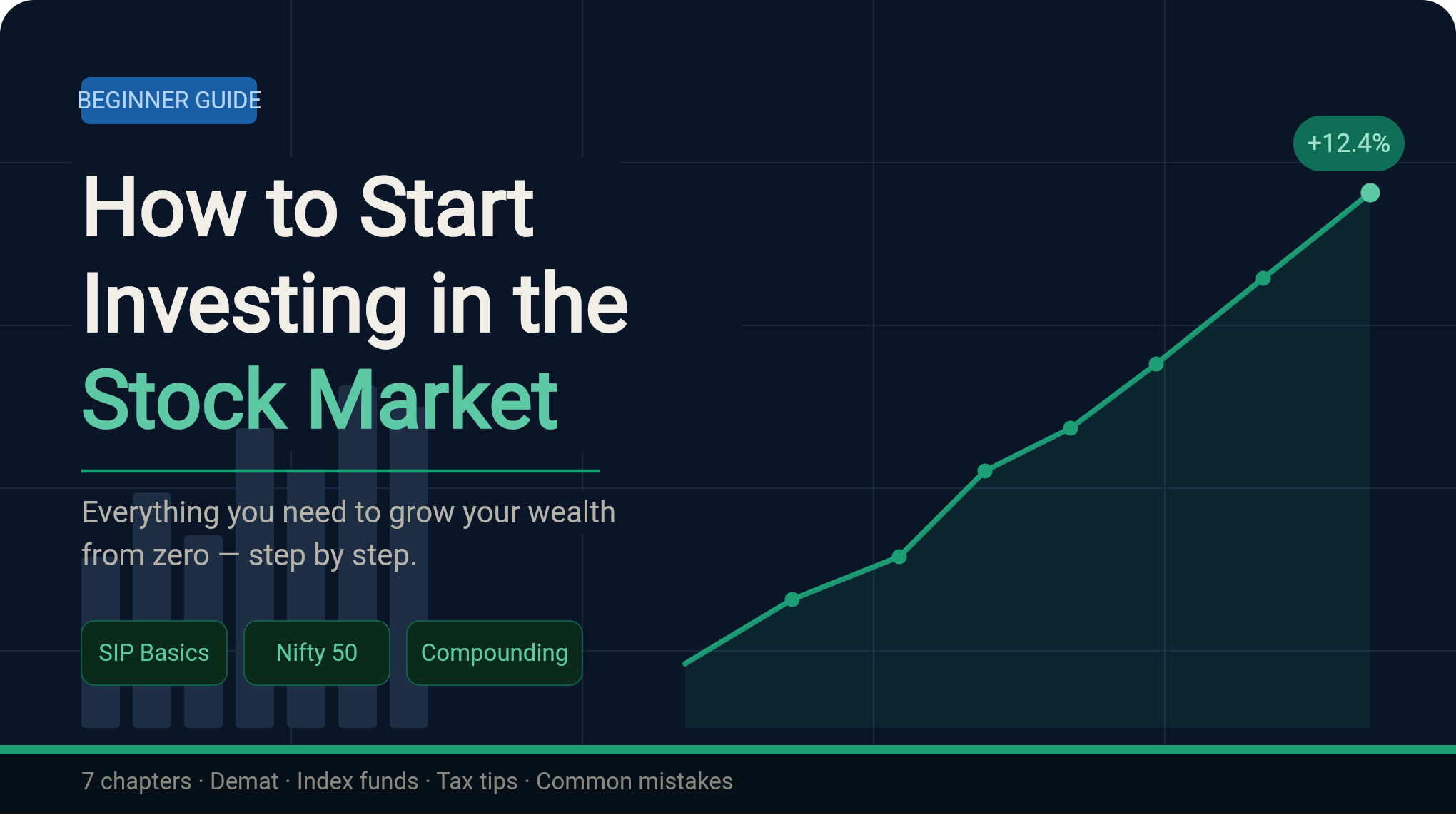
Money in a savings account loses value to inflation. Investing lets your money work for you — and time is your greatest asset.
1. What is the Stock Market?
The stock market is a marketplace where buyers and sellers trade shares of publicly listed companies. When you buy a stock, you’re purchasing a small ownership stake in that company. If the company grows and becomes more valuable, so does your investment.
Think of it this way: if you owned 1% of a chai stall that later became a national chain, your 1% stake would be worth far more than when you first bought it. That’s exactly how stocks work — at scale.
Key Terms to Know
| Term | What it Means |
|---|---|
| Stock / Share | A unit of ownership in a company |
| Exchange (NSE/BSE) | The official platform where stocks are listed and traded |
| Index (Nifty 50 / Sensex) | A benchmark tracking performance of top stocks |
| Bull Market | A period when stock prices are generally rising |
| Bear Market | A period when stock prices are generally falling |
| Portfolio | Your collection of all investments |
| Broker | A platform or person through whom you buy/sell stocks |
Both bull and bear markets are normal cycles. Knowing this prevents panic when prices fall.
2. Why Should You Invest?
The Problem with Just Saving
If inflation runs at 6% per year and your savings account gives you 3.5%, you are effectively losing purchasing power every year. ₹1,00,000 today will buy less in 10 years if it just sits in a bank.
The Power of Compounding
Compounding means earning returns on your returns. Over time, this creates an exponential curve — not a straight line.
Example: ₹5,000/month SIP at 12% annual return
| Years | Amount Invested | Final Value | Gains |
|---|---|---|---|
| 5 years | ₹3,00,000 | ₹4,12,432 | ₹1,12,432 |
| 10 years | ₹6,00,000 | ₹11,61,695 | ₹5,61,695 |
| 15 years | ₹9,00,000 | ₹25,22,880 | ₹16,22,880 |
| 20 years | ₹12,00,000 | ₹49,95,740 | ₹37,95,740 |
| 30 years | ₹18,00,000 | ₹1,75,29,132 | ₹1,57,29,132 |
The takeaway: The amount you invest matters less than how early you start. Starting at 22 vs 32 can mean a difference of crores by retirement.
3. Getting Started: Step by Step
Step 1 — Open a Demat + Trading Account
To buy or sell stocks in India, you need two accounts:
- Demat Account — stores your shares electronically (like a digital locker)
- Trading Account — used to place buy/sell orders
Popular brokers in India:
| Broker | Best For | Account Opening Fee |
|---|---|---|
| Zerodha | Active traders | Free |
| Groww | Beginners | Free |
| Upstox | Low-cost trading | Free |
| Angel One | Full-service + research | Free |
| HDFC Securities | Bank-linked convenience | Paid |
Step 2 — Complete KYC Verification
KYC (Know Your Customer) is mandatory. You’ll need:
- PAN Card
- Aadhaar Card (for OTP-based e-KYC)
- Bank account details
- A selfie/signature
Most brokers complete this digitally in under 10–15 minutes.
Step 3 — Link Your Bank Account
Add funds to your trading account via UPI, NEFT, or IMPS. Start with an amount you’re completely comfortable losing — this is your learning capital.
Tip: Never invest your emergency fund, rent money, or loan money in stocks.
Step 4 — Make Your First Investment
Beginners should start with one of these:
- Nifty 50 Index Fund via SIP — safest, most diversified
- Large-cap Mutual Fund — professionally managed, lower risk
- Blue-chip stocks (Reliance, TCS, HDFC Bank) — stable, established companies
Avoid penny stocks, intraday trading, and F&O (Futures & Options) until you have at least 1–2 years of experience.
Step 5 — Stay Consistent and Review Periodically
- Set up a monthly SIP and automate it
- Review your portfolio every 6 months — not every day
- Rebalance once a year if needed
- Keep investing even when the market is down
4. Types of Investments to Know
Direct Stocks
Buying shares of individual companies directly. You research companies, assess their fundamentals, and decide how much to invest.
- Risk: High (company-specific risk)
- Return Potential: High
- Best for: Investors willing to research and monitor regularly
Mutual Funds
A fund manager pools money from many investors and invests in a diversified portfolio of stocks/bonds.
- Risk: Moderate
- Return Potential: Moderate to High
- Best for: Beginners who want professional management
Index Funds & ETFs
These passively track a market index (e.g., Nifty 50) without active fund management.
- Risk: Low to Moderate
- Return Potential: Matches market returns (~12% historically)
- Best for: Long-term, low-cost wealth building
Warren Buffett famously said: “For most investors, a low-cost index fund is the best investment they can make.”
IPOs (Initial Public Offerings)
When a private company lists on a stock exchange for the first time, it offers shares to the public through an IPO.
- Risk: High (uncertain performance post-listing)
- Return Potential: Variable
- Best for: Experienced investors with research capability
Bonds & Debt Funds
Fixed income instruments that pay regular interest. Lower volatility than equities.
- Risk: Low
- Return Potential: Low to Moderate (6–8%)
- Best for: Capital preservation and balancing a portfolio
REITs (Real Estate Investment Trusts)
Invest in commercial real estate assets and earn dividend income. Listed and traded on stock exchanges.
- Risk: Moderate
- Return Potential: Moderate (dividends + price appreciation)
- Best for: Those wanting real estate exposure without buying property
5. Key Concepts Every Beginner Must Know
P/E Ratio (Price-to-Earnings)
The P/E ratio tells you how much investors are willing to pay for every ₹1 of a company’s earnings.
- High P/E = Investors expect high future growth (but could be overvalued)
- Low P/E = Stock may be undervalued or in a struggling sector
- Compare P/E within the same industry — a bank and an IT company will have very different norms
Market Capitalisation
Total value of all outstanding shares of a company.
| Category | Market Cap | Risk Level |
|---|---|---|
| Large Cap | > ₹20,000 Cr | Low |
| Mid Cap | ₹5,000–20,000 Cr | Medium |
| Small Cap | < ₹5,000 Cr | High |
Dividend
A portion of a company’s profits is paid to shareholders. Usually quarterly or annually. Useful for passive income.
EPS (Earnings Per Share)
Net profit of the company divided by the total number of shares. Higher EPS = more profitable company.
Diversification
Never put all your money in one stock, sector, or asset class. Spread investments to reduce risk.
Example diversified portfolio for a beginner:
- 50% — Index Funds (Nifty 50 / Sensex)
- 20% — Large-cap equity funds
- 15% — Debt / Bond funds
- 10% — Mid-cap funds
- 5% — Gold (Sovereign Gold Bonds or Gold ETF)
SIP (Systematic Investment Plan)
A method of investing a fixed amount at regular intervals (usually monthly). It eliminates the need to time the market and benefits from rupee cost averaging.
When markets are down, your SIP buys more units. When markets are up, your units are worth more. Over time, this averages out your cost.
Volatility
How much a stock’s price fluctuates. High volatility = higher risk. Beginners should prefer low-volatility stocks or funds.
6. Common Mistakes to Avoid
❌ Trying to Time the Market
“I’ll invest when the market falls.” — This is the #1 mistake beginners make. No one can consistently predict market movements. Missing just the 10 best days in a decade can cut your returns in half.
Solution: Stay invested consistently. SIP removes timing decisions entirely.
❌ Investing Money You Can’t Afford to Lose
Stocks are not savings accounts. Markets can fall 30–50% and take years to recover. Never invest:
- Emergency fund
- Rent or bill money
- Money needed within 1–2 years
- Borrowed money (ever)
Solution: Build an emergency fund of 3–6 months of expenses first.
❌ Following Tips Blindly
“My friend made 10x on this stock!” — Tips on WhatsApp groups, social media influencers, and well-meaning relatives are not investment advice.
Solution: Do your own research (DYOR). Understand what you’re buying and why.
❌ Panic Selling During Market Crashes
When markets fall sharply, the emotional response is to sell everything. This is almost always the wrong move.
Historical perspective:
- The 2008 crash saw the Sensex fall by ~60%. By 2010, it had fully recovered.
- COVID-19 crash in March 2020 dropped 38%. By December 2020, it was back at all-time highs.
Solution: Stay calm. Do not check your portfolio daily. Trust the long-term thesis.
❌ Over-Diversification
Owning 40 different stocks doesn’t necessarily reduce risk — it just makes it harder to track anything. Beginners often end up with a cluttered, underperforming portfolio.
Solution: Start with 3–5 solid funds. Add direct stocks only after you understand them.
❌ Ignoring Taxes
In India, stock market gains are taxable:
| Holding Period | Tax Type | Rate |
|---|---|---|
| < 1 year | Short-Term Capital Gains (STCG) | 20% |
| > 1 year | Long-Term Capital Gains (LTCG) | 12.5% (above ₹1.25L) |
| Dividends | Taxable as income | As per slab |
Solution: Hold for the long term to benefit from LTCG rates. Keep records of all transactions.
7. Golden Rules for Beginners
Start early, start small. Even ₹500 a month matters more than waiting until you have ₹50,000. Compounding rewards time above everything else.
Invest for 5+ years minimum. The stock market is not a get-rich-quick scheme. It is a get-rich-slowly system — and it works remarkably well for patient investors.
Never stop your SIP during a market fall. A market dip is a discount sale. Your SIP automatically buys more units at lower prices — this is the entire advantage of rupee cost averaging. Stopping kills the benefit.
Keep learning continuously. Read a company’s annual report before buying its stock. Follow credible financial news. Books like The Intelligent Investor by Benjamin Graham or Let’s Talk Money by Monika Halan are excellent starting points.
Track your goals, not daily prices. Are you investing for retirement in 25 years? Your child’s education in 15 years? A house in 10 years? Measure progress against those goals — not against yesterday’s closing price.
Keep costs low. Every rupee paid in expense ratios, brokerage fees, and transaction taxes is a rupee that doesn’t compound. Index funds have some of the lowest costs available.
Separate investing from speculation. It’s fine to keep a small “fun” allocation (5–10% maximum) for higher-risk bets. But your core wealth must be built on disciplined, boring, consistent investing.
8. Recommended Resources
Books
- The Intelligent Investor — Benjamin Graham
- Let’s Talk Money — Monika Halan (India-specific, highly recommended)
- Rich Dad Poor Dad — Robert Kiyosaki (mindset foundation)
- One Up on Wall Street — Peter Lynch
- The Psychology of Money — Morgan Housel
Websites & Tools
- NSE India — Official exchange data
- BSE India — Official exchange data
- Screener.in — Company financials and screening
- Tijori Finance — Deep fundamental research
- SEBI Investor Education — Official investor resources
Trusted Platforms to Start
- Zerodha / Kite — Best for serious investors and traders
- Groww — Best for beginners and mutual funds
- ET Money — Great for mutual fund SIPs
- MF Central — Unified mutual fund portal by AMFI
Final Thought
The best investment you can make is in your own financial education. You don’t need to be a finance expert — you just need to start, stay consistent, and resist the urge to react emotionally to market noise.
The market rewards the patient and punishes the impatient.
Start with ₹500. Start today.
This post is for educational purposes only and does not constitute financial advice. Please consult a SEBI-registered financial advisor before making investment decisions.